Zero-Click Search is a search behavior where a user’s query is satisfied directly on the Search Engine Results Page (SERP) via AI Overviews, featured snippets, or interactive tools, eliminating the need to click through to a website. In 2026, this has become the default standard for informational queries, forcing marketers to shift their SEO strategy from chasing organic traffic to optimizing for Answer Engine visibility, structured data extraction, and brand citation within AI summaries.
Introduction
It’s the nightmare scenario every marketer feared back in 2024: You rank #1 for a high-volume keyword, but your organic traffic is flatlining. Why? Because the user never visited your site. They got their answer, closed the tab, and moved on.
Welcome to the era of Zero-Click Search.
In 2026, Google isn’t just a signpost pointing to websites; it’s an answer engine. Between AI Overviews, interactive tools, and hyper-intelligent snippets, the search engine results page (SERP) has become the destination itself. For marketers, this requires a fundamental shift in mindset. The goal is no longer just “getting the click”—it’s about owning the answer.
In this guide, we’ll break down exactly what zero-click search means for your strategy and how to survive in an ecosystem where visibility doesn’t always equal traffic.
What Is Zero-Click Search? (Quick Definition)
Zero-Click Search occurs when a user’s query is answered directly on the Search Engine Results Page (SERP), removing the need to click through to a third-party website.
Instead of acting as a gateway, Google delivers the solution via:
- AI Overviews (SGE)
- Featured Snippets
- Knowledge Panels
- Local Map Packs
- Instant Calculators & Tools
In 2026, this is no longer a “trend.” For informational queries, it is the default behavior.
Why Zero-Click Search Is Reshaping SEO
Search behavior has evolved. Users today expect friction-less answers. If Google’s AI can tell them “how to tie a tie” or “the weather in London” instantly, they have zero incentive to visit a blog post buried under pop-ups and ads.
Industry data suggests that well over 60% of all searches now end without a click. As AI-generated summaries become more accurate, that percentage will only climb.
For marketers, this creates a paradox:
- Organic Click-Through Rates (CTR) are down.
- Traffic appears to be dropping.
- Yet, brand exposure might actually be at an all-time high.
Visibility hasn’t disappeared; it has shifted. Brands now gain market share when their content is cited in AI Overviews or extracted for a Featured Snippet. The battleground has moved from “traffic volume” to “share of voice.”
💡 Pro Tip: The “Billboard Effect”
Treat Zero-Click results like a digital billboard on a highway. Drivers (users) might not stop at your store (website) immediately, but they see your logo and your answer. When they eventually do need to buy, they remember the brand that gave them the answer.
Real-World Examples of Zero-Click Searches
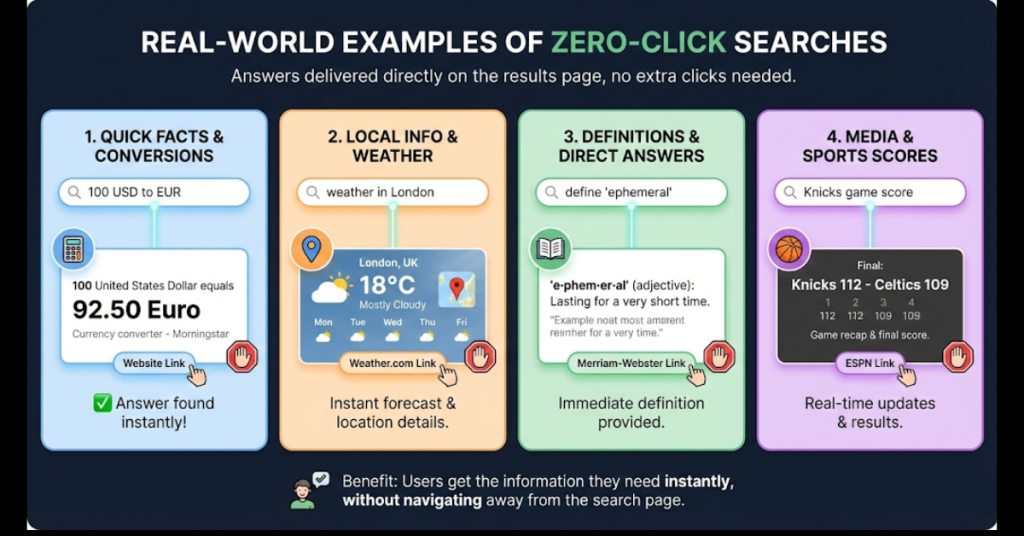
To understand the impact, look at how different industries are being affected in 2026:
- Informational Queries:
- Query: “What is the capital of Australia?”
- Result: A direct text answer (Canberra). No clicks needed.
- Local Intent:
- Query: “Italian restaurants open now.”
- Result: A Google Map pack with ratings and hours. The user calls directly from the SERP.
- Utility & Tools:
- Query: “USD to INR today” or “Mortgage calculator.”
- Result: Interactive widgets that solve the problem instantly.
- Comparison Queries:
- Query: “iPhone 17 vs Samsung S26 specs.”
- Result: An AI-generated comparison table highlighting key differences.
- Health & Lifestyle:
- Query: “How many calories in an avocado?”
- Result: A nutrition panel on the right-hand side.
The Reality: If your content only provides basic facts that an AI can easily summarize, you will lose that traffic.
Why Traditional SEO Metrics Are Misleading
For two decades, we measured SEO success by rankings, sessions, and pageviews. In a zero-click world, those metrics are half-blind.
You can rank #1 and see a 30% drop in traffic because an AI Overview is satisfying the user’s intent immediately. However, looking only at traffic ignores the “Assisted Conversions.”
- User sees your brand in an AI summary.
- User remembers your authority.
- User later performs a Branded Search (e.g., “NewsX Nation marketing guide”) and converts.
New Metrics for 2026:
- Share of Model (SoM): How often is your brand cited in AI answers?
- Branded Search Volume: Is direct interest in your company growing?
- Featured Snippet Ownership: Are you controlling the “position zero” real estate?
AI Doesn’t Rank Pages — It Selects Sources
This is the most critical shift. Traditional search engines ranked lists of links based on backlinks and keywords. AI search engines synthesize answers by selecting trusted sources.
AI systems prefer content that is:
- Structured: Uses clear schemas and formatting.
- Factual: High accuracy with citations.
- Authoritative: Written by experts with verifiable experience (E-E-A-T).
If your content is fluffy, vague, or buried in walls of text, the AI will ignore it. Zero-click SEO is about becoming a trusted source for the machine.
Practical Content Guidelines: Writing for Machines & Humans
To survive in 2026, your content strategy needs to pivot. You are writing for two audiences: the user (who wants depth) and the AI (which wants structure).
1. The “Inverted Pyramid” Style
Don’t bury the lead. Answer the main question in the very first paragraph.
- Bad: “Many people wonder about the weather…”
- Good: “The weather in London today is 15°C with light rain.”
2. Structure for Extraction
Use formatting that makes it easy for AI to “grab” your content.
| Content Element | Why AI Loves It |
| Direct Answers | Allows for instant extraction into snippets. |
| Bullet Points | easy to summarize into lists. |
| Data Tables | perfect for comparison queries. |
| Expert Quotes | Adds trust signals and authority. |
3. Answer, Don’t Tease
Clickbait is dead. If you force users to click to get the answer (“You won’t believe reason #4!”), the AI will simply bypass you and cite a competitor who gave the answer upfront.
💡 Pro Tip: The “Definition + Depth” Strategy
Start every article with a concise definition (for the AI to scrape). Then, follow it up with deep, nuanced analysis, case studies, or personal stories (which AI cannot easily replicate). This satisfies the zero-click user while enticing the power user to click through.
Why E-E-A-T Is Critical in Zero-Click SEO
Experience, Expertise, Authoritativeness, and Trustworthiness (E-E-A-T) are not optional in 2026.
With AI generating millions of generic articles a day, Google places a premium on human experience.
- Who wrote this? AI checks for author bios and credentials.
- Is it real? AI looks for unique data, original photos, and first-hand anecdotes.
To strengthen your signals:
- Add detailed author bios with links to LinkedIn.
- Cite original research or proprietary data.
- Avoid anonymous “Admin” publishing.
The Power of Branded Search in an AI World
Here is the silver lining: Branded search queries cannot be summarized away.
When a user searches for “NewsX Nation SEO Guide” or “Nike running shoes,” the intent is specific. The AI cannot replace your brand’s homepage.
Therefore, the ultimate defense against zero-click search is building a brand.
- Create proprietary frameworks (e.g., “The Skyscraper Technique”).
- Coin unique terminology.
- Publish research that others must cite.
When users start searching for you by name, you become immune to the algorithm.
Conclusion
Zero-click search isn’t the death of SEO; it’s the maturation of it. The game has changed from “traffic arbitrage” to “brand influence.”
In 2026, success isn’t just about how many people visit your website—it’s about how many people see your answers, trust your authority, and eventually seek out your brand.
- Structure your content for AI extraction.
- Build deep authority (E-E-A-T).
- Focus on branded search growth.
Those who adapt to becoming the “source of truth” will remain visible, even when the user never clicks.
Video is one of the few content formats that dominates search results and grabs attention instantly. Learn how to create professional video assets for your brand in our guide: [Static Camera Shots in AI Videos: A Complete Beginner’s Guide]. Join thousands of marketers staying visible with NewsX Nation’s Weekly Tech & Marketing Insights.